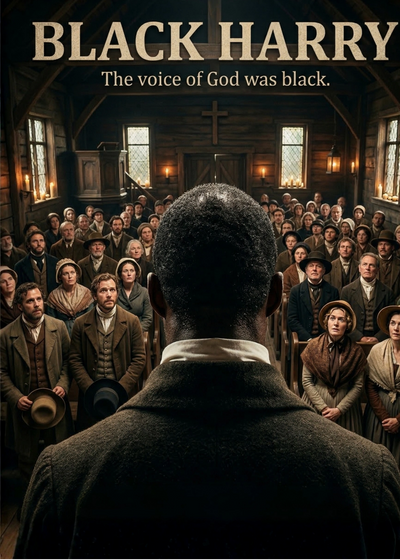
BLACK HARRY - 90 Min. Historical Film
- Format: Feature film
- Genre: Historical drama
- Location: Charleston, South Carolina, 1831
- Development stage: Treatment, Character Bible, Pitch Deck, Score
- Seeking: Producing, writing and strategic development partners
- Created by: Lizz M. Smoak
In the turbulent years following the American Revolution, Harry Hosier—born into slavery around 1750 —emerges as an unlikely prophet. Illiterate yet gifted with an extraordinary memory for Scripture, the man known as “Black Harry” gains his freedom amid wartime chaos and the spirit of manumission sweeping the Upper South. As carriage driver and servant to Bishop Francis Asbury, the “Father of American Methodism,” Harry discovers his true calling: a voice so powerful it can move thousands to tears and repentance.
The film opens with Harry’s visceral conversion—a midnight vision of the barren fig tree from Luke 13 that refuses to bear fruit while souls starve. In 1781, at Adams’s Chapel in Virginia, he delivers his landmark sermon on the same parable to a Black congregation, the first recorded sermon by an African American Methodist. Soon, Harry “warms up” crowds for Asbury, his thunderous oratory drawing even larger audiences than the bishop himself. Harry preaches to mixed and all-white congregations, including a historic sermon in Delaware. His eloquence earns praise from Founding Father Dr. Benjamin Rush, who declares him “the greatest orator in America.”
As Harry travels the circuits from the Carolinas to New England, camp meetings explode with interracial ecstasy—Black and white worshippers singing spirituals like “We Are Climbing Jacob’s Ladder” and “Go Down, Moses” side by side under starlit skies. He preaches against slavery with moral fire, echoing the young nation’s Revolutionary ideals and the church’s early anti-slavery resolutions, while news of the U.S. Constitution’s compromises and the Northwest Ordinance’s free-soil promise filters through frontier roads. Yet success breeds resentment. White preachers chafe at sharing pulpits with an unordained Black man; Southern planters issue threats. In 1791, Harry is quietly excluded from full fellowship on vague charges of “arrogance.” A secret love affair with a white woman is whispered throughout the elders.
Devastated and adrift, Harry spirals into a dark wilderness. Found ragged and drunk in Philadelphia streets, he cries out Psalm 51 like a biblical prophet unraveling, confronting the trauma of bondage, betrayal, and a church that extracts his gift but withholds belonging. Through solitary prayer, small frontier revivals, and quiet reconciliation with Asbury, Harry claws his way back—his faith deeper, his preaching more prophetic.
A lyrical epilogue intercuts his burial with subtle visions of legacy: Richard Allen founding the African Methodist Episcopal Church, camp-meeting fires fueling the Second Great Awakening. As the camera rises over an empty frontier road at dusk, Harry’s disembodied voice thunders the parable of the fig tree one final time.
Black Harry is the true story of a man who never read the Bible, yet whose spoken word shook a young nation still wrestling with liberty and chains. In two hours of sweeping landscapes, intimate doubt, and electrifying sermon sequences set to soaring spirituals, Harry Hosier stands as an American prophet—his voice outliving every law and institution that tried to silence it.
Confidential — For Development Consideration Only | © Holy Smoak Studios